VG PG base mix and the ratio your nicotine shots leave behind
The label makes it look settled. A VG PG base mix carries its ratio in large print, 50/50, 70/30 or 80/20, and most people pick that figure to suit their kit. Yet the ratio describes the bottle as it leaves the shelf. The moment a nicotine shot goes in, it brings its own glycerine and its own propylene glycol, and the liquid that reaches the tank no longer has quite the make-up you chose. The real question is how far it drifts.
What a VG PG base mix actually is
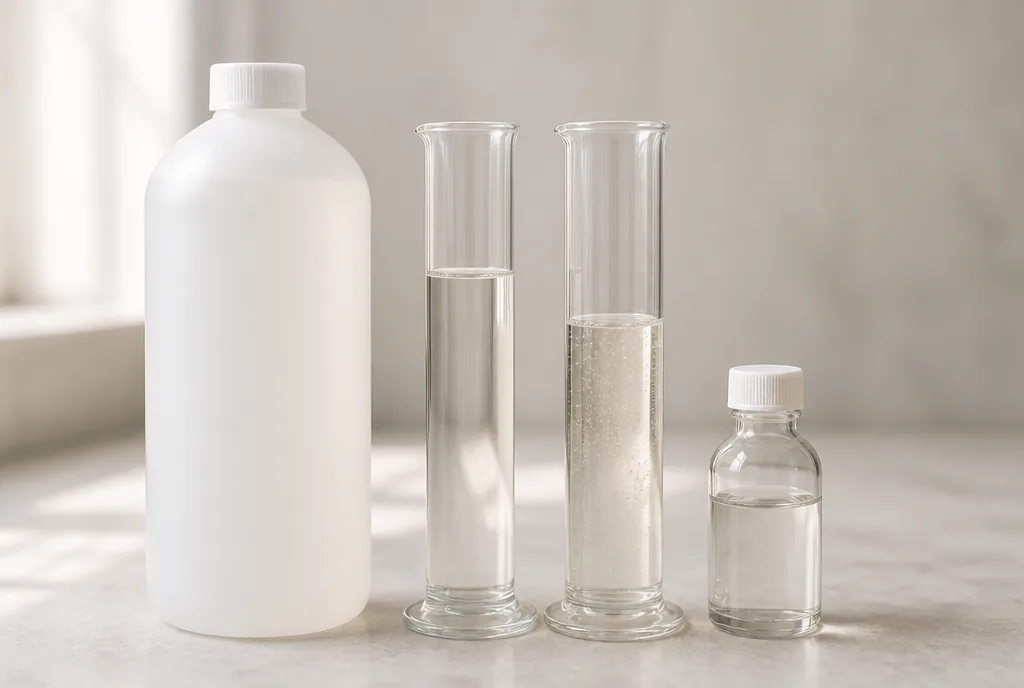
A VG PG base mix is vegetable glycerine (VG) and propylene glycol (PG) blended to a set ratio, with no nicotine and no flavouring. It forms the main body of a home mixed e-liquid, to which a flavour concentrate and, if wanted, nicotine shots are added.
PG carries flavour and sharpens the sensation at the back of the throat, while VG thickens the liquid and produces denser vapour. The ratio, expressed in percentages, simply states the share of each.
The absence of nicotine is a matter of law rather than marketing. Under the Tobacco and Related Products Regulations 2016, nicotine-containing liquid may only be sold in refill containers of up to 10 ml, at no more than 20 mg/ml, and tanks are capped at 2 ml. Nicotine therefore comes separately in 10 ml shots, while a nicotine free base mix can be sold in large bottles.
Reading the ratio the right way round
British labels usually give the VG figure first, so a 70/30 base mix holds 70% vegetable glycerine and 30% propylene glycol. Vampire Vape, for instance, sells its base as 50VG/50PG and describes that blend as a universal base for most devices, keeping higher VG mixes for coils built to handle thicker liquid.
Bottles made in France usually follow the opposite convention and quote PG first, so a French 30/70 is the same blend as a British 70/30. On a 50/50 the order is irrelevant, but on anything else it flips the reading, which is why the letters next to the numbers matter more than the numbers alone.
Retailers commonly list 50/50, 60/40, 70/30 and 80/20 mixes. The thinner blends suit lower powered kits with higher resistance coils, while the thicker ones belong in sub ohm tanks.
What a nicotine shot does to a VG PG base mix
Pouring a shot into a VG PG base mix changes three things at once, the nicotine strength, the total volume and the ratio. The third almost always goes unnoticed, even though it directly affects how thick the liquid is.
Strength and volume
A British freebase shot is usually 10 ml at 18 mg/ml, so 180 mg of nicotine a bottle, while nic salt shots are commonly 20 mg/ml. Each one adds nicotine and also 10 ml of liquid. How many to pour for a given volume is set out, tables included, in our guide on how many nicotine shots a bottle needs.
The shot’s own ratio
A shot is not pure nicotine but a nicotine base with a ratio of its own. Freebase shots come in 50/50, 70/30 and 80/20 VG/PG, while salt shots are sold in 50/50 or, from some makers, in 100% VG.
The usual advice is to match the shot to the liquid, with 50/50 for pod kits and mouth to lung vaping, and 70/30 or 80/20 for shortfills and high VG vaping. The principle is sound, but a shot in exactly the ratio of your base is not always available, and then the final ratio has to be worked out.
The share of shots in the bottle
Everything starts from one proportion. With 18 mg/ml shots poured into a nicotine free base, the share of shots in the finished bottle equals the target strength divided by 18.
A 3 mg/ml mix is therefore one sixth shots, about 16.7%, and a 6 mg/ml mix is one third shots. With 20 mg/ml salt shots, divide by 20 instead, which gives 15% for 3 mg/ml.
That proportion holds whatever volume you make, and even when a flavour concentrate takes up part of the bottle. The final ratio is then a weighted average. Final VG share = (base share x VG in the base) + (shot share x VG in the shots).
The higher the figure, the closer the final ratio moves towards that of the shots. At 6 mg/ml a third of the bottle comes from them, and a 70/30 base mix topped up with 50/50 shots ends at about 63/37, giving away much of the thickness it was chosen for.
A worked example
Take 50 ml of 70/30 base mix and one 10 ml shot at 18 mg/ml in 50/50. The bottle ends at 60 ml and holds 180 mg of nicotine, so 3 mg/ml. On the VG side the base contributes 35 ml and the shot 5 ml, which makes 40 ml out of 60. The liquid you vape is therefore close to 67/33, not 70/30.
The table applies the same method to a 3 mg/ml mix made with 18 mg/ml shots, so one sixth shots and five sixths base. The figure is there purely as a calculation example and is not a recommendation.
| Base mix (VG/PG) | 50/50 shot | 70/30 shot | 80/20 shot |
|---|---|---|---|
| 50/50 | 50/50 | 53/47 | 55/45 |
| 60/40 | 58/42 | 62/38 | 63/37 |
| 70/30 | 67/33 | 70/30 | 72/28 |
| 80/20 | 75/25 | 78/22 | 80/20 |
Where the two ratios match, nothing moves. Elsewhere the shift is a few points, small on paper but noticeable in a tank set up for one particular thickness, and it doubles whenever the target strength doubles.
Aiming at a final ratio rather than a label ratio
The formula reverses easily. VG needed in the base = (target VG - shot share x VG in the shots) / base share.
To finish near 70/30 at 3 mg/ml with 50/50 shots, the base needs about 74% VG, a ratio few bottles carry. Blending equal parts of 70/30 and 80/20 gives 75/25, which lands at roughly 71/29 once one shot per 50 ml goes in.
The same reasoning applies to shortfills, which are flavoured base mixes with their own ratio on the label. Our page on Heisenberg e-liquid shows how mixing a shortfill also moves its flavour balance. When mixing from scratch, a flavour concentrate made up in propylene glycol simply becomes a third line in the weighted average.
Bottle sizes and storage
Base mix is sold in bottles of 500 ml and larger, as well as in smaller sizes. Whatever the format, check the ratio printed on every bottle involved, shots included, since together they decide the final blend.
Keep the base mix tightly closed, somewhere dry, at room temperature and away from light. Shots call for more care because they contain concentrated nicotine, and our nicotine shot guide covers handling and storage in detail.
FAQ
A few practical cases come up once the base is chosen. The answers below apply the same arithmetic to situations the article has not covered.
Can two base mixes with different ratios be blended?
Yes, and the result works out exactly as it does with shots. Mixing 50 ml of 70/30 with 50 ml of 50/50 gives 100 ml containing 60 ml of VG, so a 60/40. It is a simple way to reach an in-between ratio.
Why does a high VG mix seem thinner once a shot goes in?
Because a 50/50 shot carries more propylene glycol than a 70/30 or 80/20 base. The finished liquid ends up richer in PG, and therefore thinner. A shot in the same ratio as the base avoids the effect.
Is a shortfill worked out the same way as a base mix?
Yes. Its label states a ratio, and every shot poured in moves it by the same weighted average. The only difference is the flavouring, already in the bottle and usually measured with the intended number of shots in mind.
Can a mix that has turned too thin be rescued?
Yes, by adding pure VG, although the nicotine strength falls at the same time. Adding 10 ml of VG to 60 ml of a 67/33 mix at 3 mg/ml gives 70 ml at about 71/29 and roughly 2.6 mg/ml, so both values need recalculating.
How much base mix for 120 ml at 3 mg/ml?
With 18 mg/ml shots, two shots and 100 ml of base mix, without flavouring. When mixing from scratch, the flavour concentrate comes out of the base volume, never out of the shots.
Choosing a VG PG base mix for the ratio you will actually vape
The ratio on a base mix describes a starting point, not the liquid that ends up in the tank. Shots add their own make-up, more heavily as the target strength rises.
The method comes down to three steps. Read the letters next to the numbers, work out the share of shots by dividing the target by the shot strength, then take the weighted average of the ratios.
Chosen with that calculation in mind, a VG PG base mix leads to the blend you planned, and the same habit of checking the numbers runs through everything else on Repère Booster.
Related guides
- How many nicotine shots, the exact calculation
- Nicotine shot, the complete guide to using one
- Heisenberg e-liquid, mixing and strength explained
Editorial content for adult readers only. Nicotine is a highly addictive substance. Nicotine vaping products are not for sale to anyone under 18 in the UK. This article is not a buying recommendation.